
Editor’s Note: If you’re enjoying the NSL Final coverage this weekend, consider buying me a coffee ☕. Thanks for reading and supporting the newsletter.
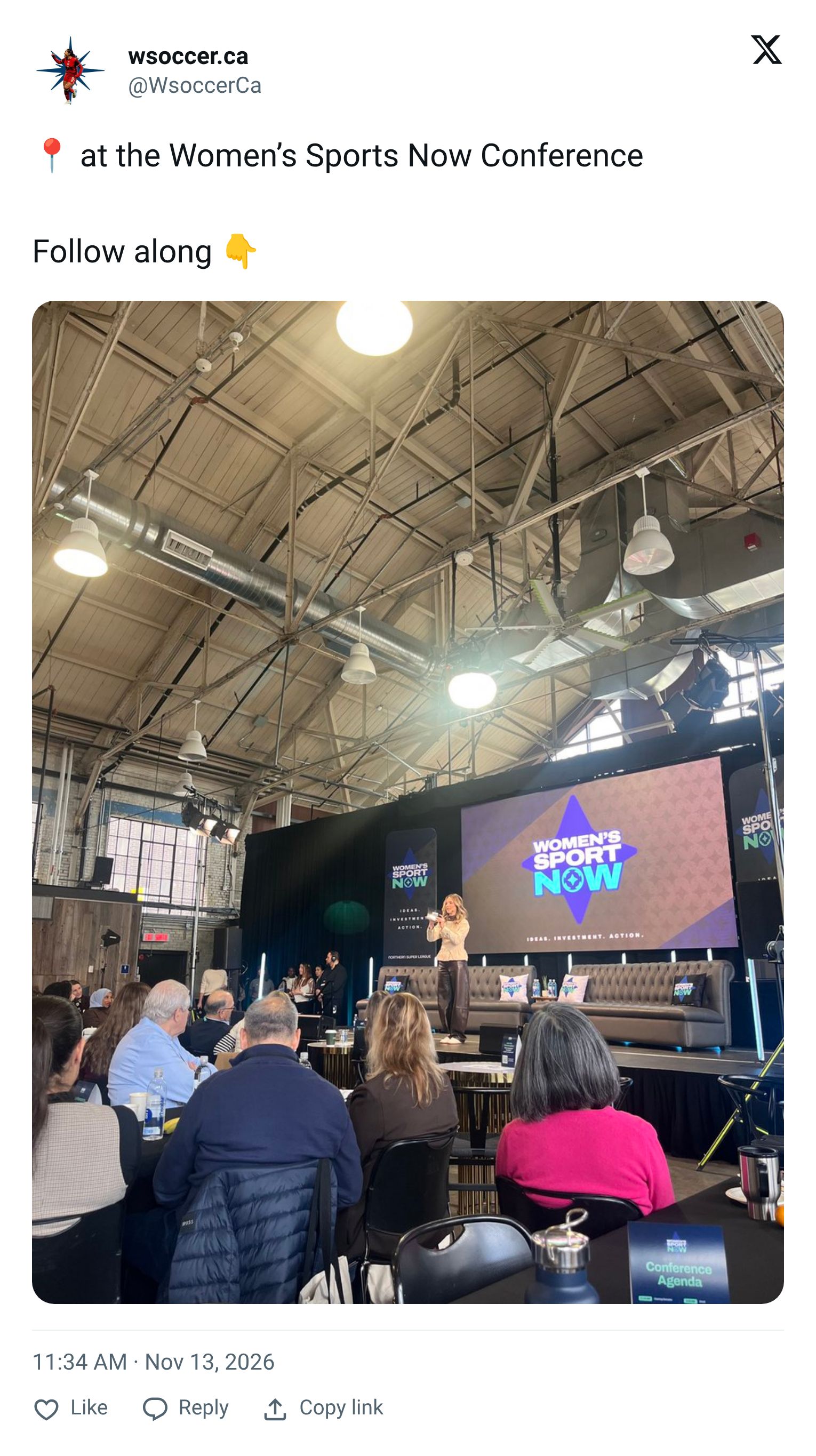
After Thursday’s media day at TD Place, Friday was less about Saturday’s Final and more about everything around it. The NSL hosted its first-ever Women’s Sport Now conference, and for one day the conversation zoomed out: who built this league, who’s paying for it, and who it’s really for.
It would take days to put into words the breadth and depth of the conversations. Kudos to the NSL staffers who pulled off a conference while preparing for a final.
While broadcasters put final touches on their plans for the Final, everything from run-downs to cues to extensive notes by the commentary team, members of the media watched teams train, and there was a community practice targeted at young girls in the community, which a few of the non-playing players, such as Syd Kennedy, attended.
I chose instead to attend the conference to get a sense of the conversations being held at the highest levels, and who is taking part in them. Here are three key themes gleaned from these discussions.
The Generation that changed the game forever
Sometimes it’s good to just take a step back and be grateful for the fact that the generation that brought us the biggest rise in the Canadian women’s game on the pitch, from the 2002 U19 World Cup and the best-ever finish at the 2003 World Cup, to the Olympic bronzes followed by gold in 2021, also brought us the NSL.
Sarah Spain’s Good Game live podcast will drop soon enough, so you’ll be able to listen to the edited version then, but that segment certainly got the most attention and had a few juicy parts. Spain is such a pro and generously introduced Desi Scott, Diana Matheson, Erin McLeod, and Carmelina Moscato. Seriously, the intros were ridiculously long-winded, because, come on, what have these women not achieved on and off the pitch?
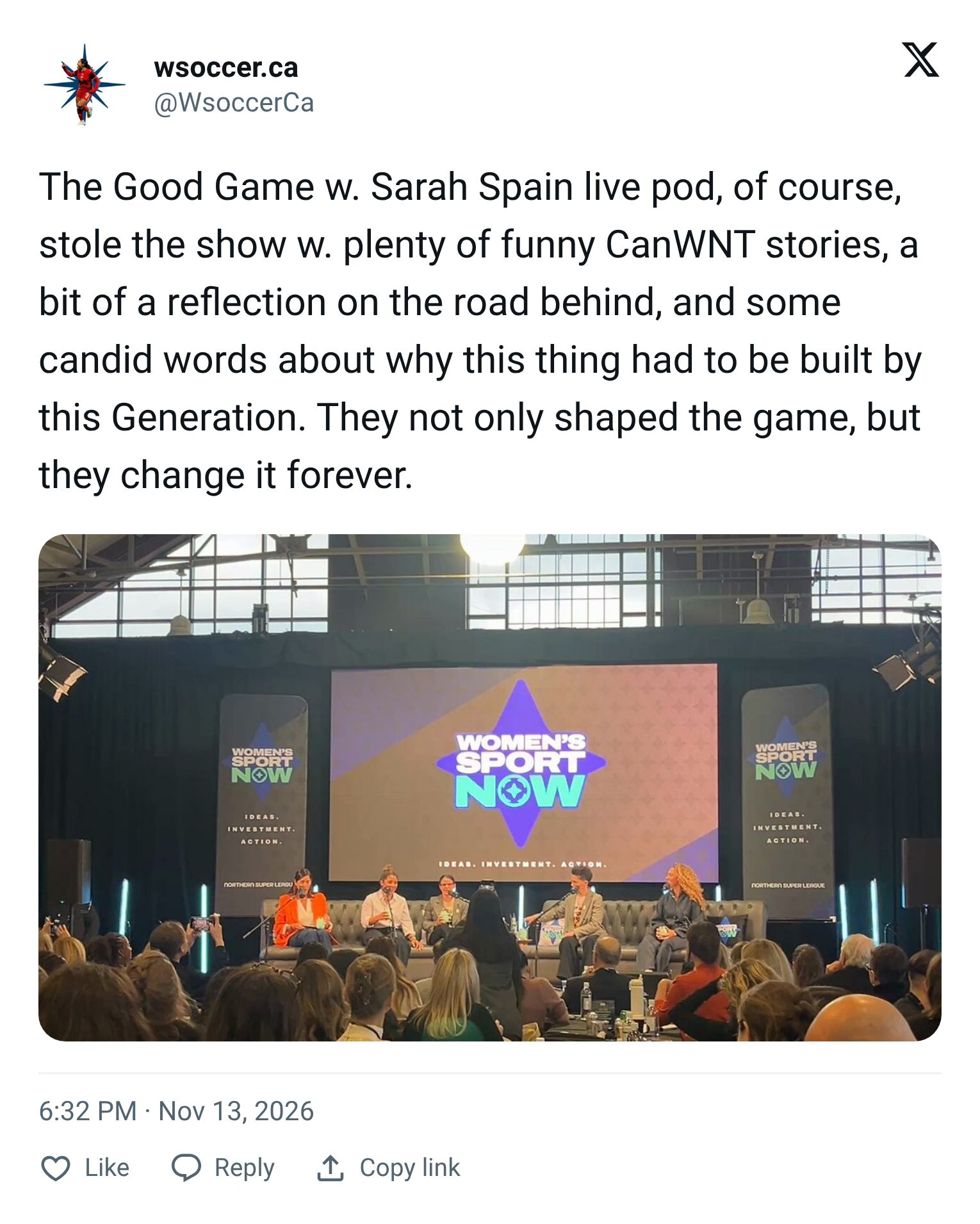
There were some hilarious inside jokes, from “Love Seminars” to “Abby, do something!”, a line a fan once yelled at USWNT great Abby Wambach that they apparently still say to each other. The banter was back like it had never left, chirps were flying, and there may even have been some a cappella Christmas music (I’ll let you guess who participated). It was cool to hear these legends reflect on some of the milestones, trials, and tribulations they went through together, how it felt to be experiencing them, what changed in the landscape because of their successes, and how a lack of resources meant that the correct infrastructure wasn’t in place to support turning those moments into movements.
When asked why she had to build this thing herself, Diana said that it was certainly not Plan A or B, and that she did not necessarily want to be the one building it, but there were some real barriers at the time.
“I would say, also, the men in positions of power, who we all experienced in women's sport, women's soccer, our entire careers. They were in charge of the game, they were in the decision-making seat, but they did not understand, believe or imagine that women's sport could be a business.”
“But part of the driver was the idea of regret. If I didn't do it, if people like us didn't do it, those guys weren't actually going to do it. Or they were going to build a shitty version of it and they were going to say, ‘See, no one wants to do this.’”
To be fair, Carmelina Moscato did give the CSA some credit, stating that after the 2012 Olympics, the federation delivered what the players needed by co-creating the NWSL alongside the USSF and Mexican federation. Leave it to Carm to be diplomatic and graceful while still speaking truth to power. While she’s still trying to lay low out of respect for Katrine Pedersen, whom she gave a generous thank you for laying the foundations, it’s clear that she’s ready to go, and Ottawa is excited to have her. Moscato also spoke about her decision to leave Canadian soccer to pursue coaching.
“So actually, our story links. So Diana's story about our presentation to the board at the time, at Canada Soccer, was my tipping point as a professional.
“I was in a multitude of jobs at Canada Soccer, anywhere from club technical director to Canadian Soccer Business Manager of Women’s professional development, whatever that was at the time, broadcasting, I was dipping my toe in everything you possibly could do, and I don’t regret one of those career decisions for a second. But the second that it was that hard, like she said that meeting killed us, I actually said, ‘I wish you the best of luck. I love you to death, but I’m going to go coach.’
“That's what I have control over. That’s where I know I can try to be the best I can be at that. So I left. That was my decision right there.”
That wasn’t easy to hear, but it was an important step in her journey that now poetically leads to her coming back to Canada as an experienced, world-class coach, one of the new faces of the league, of her generation. To finally see her coach in the pro women’s league she fought so hard for years ago is truly special. Things didn’t work out how she hoped in Saudi Arabia, so
“When the Rapid called it didn’t take much, I kind of played a little hard to get. Like okay, let’s play the game a little.”
She’ll be overseeing plenty of games, some of them against Desi Scott, one of her new rivals. Scott, now co-founder of Winnipeg Ember, reflected on her chance to sign with Ottawa and rewrite her script, and explained her ambitions for her hometown club. Make sure to tune into the full podcast when it drops early next week to learn what they're prioritizing in Winnipeg.
Big Tent Energy
I had never heard Mark Cohon, the NSL chairman, speak before. He moderated the panel with NSL, PWHL, and Toronto Tempo leadership. While it was nice, if unsurprising, to hear that the three entities have been collaborating and helping each other from day one, the nicest moment of the panel came afterwards. Cohon took the crowd through some of his vast experience, including NBA while WNBA was coming up, MLB, CFL, etc., and went on to say that building the NSL with Litz and the team has been his favourite challenge, partly because of that collaboration. He ended by inviting others to the table and building “a bigger tent”.
Earlier in the panel, the three leaders compared the challenges and opportunities facing their organizations, and the common theme was investment. Purpose-built facilities were a theme, particularly for player recruitment and scheduling, but also for driving revenue. All three spoke about the importance of investing in storytelling and player experience. But where is that investment going to come from? Not Canadians, thus far, it seems.
Diana Matheson isn’t one to shy away from honest words, and her words carry weight. She’s ambitious, she’s bold, and she’s proven herself to be capable of accomplishing nearly everything she’s set her eyes on thus far. She pulled together a league out of thin air, in a Canadian soccer landscape littered with obstacles, doubters, and straight-up sabotage. So when she says the country’s top wealth has yet to invest in women’s sport, we listen. The elephant was in the room. APEX, a European athlete-led investment firm and a significant player in the space, invested in Canadian women’s soccer this year, as has Mark Mitchell, an American businessman with Canadian roots. Canadian wealth has not stepped up to the table, and it was a major talking point today, and yesterday at the press conference too.
We heard publicly for the first time from Luis Vicente, chairman of APEX, about what he sees in the NSL and where he sees potential for growth.
“This is your opportunity to build what I believe will be the biggest sport in the world.”
The next frontier: what happens in 2027?
This summer, everyone showed up for the World Cup. Nobody’s pretending the two events are on the same scale, but there was a bit of a “we best be seeing you” vibe in the room. The NSL doesn’t control the marketing dollars of the hundreds of Canadian companies that got behind the 2026 World Cup. But they will be watching who steps up to the table for the Women’s World Cup in 2027. The league sees the huge opportunity ahead with the first time that a Canadian women’s pro club will be listed on roster sheets at a senior World Cup. They expect to have several Canadians and players from other nations in the tournament. What does that mean for storytelling, who will showcase these talents, how can this moment be used to elevate Canadian women’s soccer in 2027 and beyond? These were the big questions lingering after today.
The other frontier came up several times, in the Rally Report and in comments from the youth panelists and youth club leaders in the room: there is currently a disconnect between the grassroots and the emerging pro game. Yes, girls are more encouraged to participate in sport due to having role models, but that influence is fragile, with awareness, access, and coverage all playing a part in how young girls and boys access (or don’t access) pro women’s sport. My own hot take, which wasn't discussed: because the NSL is at the mercy of scheduling around other tenants, it isn’t able to establish a routine to plan around, meaning many youth players’ schedules regularly conflict with NSL games. I mean, the girls on the panel have a conflicting game TODAY, AND there’s a reason that when asked who their favourite NSL player is, they named Ella Toone instead.
No hate though, they were put on the spot, and this is clearly an area of growth. Shoutout goes to one of the other youth panelists, Celia from the Gloucester Hornets, for the best quote of the day, when she succinctly answered “the ego of men in charge” when asked what she’d like to see change in Canadian sport. Nothing like a 16-year-old to call it like it is.
Speaking of a man in charge, APEX chairman Luis Vicente pointed out that same gap in the Canadian landscape. He said connections with communities are key, and he sees an opportunity in closing the disconnect between the pro game and the grassroots in North American sports. Maybe a Euro-centric angle, but I tend to agree.
Celia named the problem. Diana named who’s missing from the table. Vicente named the opportunity. The question heading into 2027 is who in Canada steps up to seize it.
For now, though, there’s a trophy to hand out. Toronto or Montreal: Day Three tomorrow. See you there!
PS. If you haven't read the Final Preview yet, check it out here.