Table of Contents
Editors Note: If you enjoy the NSL, CanWNT, and Canadian soccer coverage, consider buying me a coffee ☕. Thanks for reading and supporting the newsletter.
Just over a year ago, these teams met in a semifinal series Toronto won handily, 6–1 on aggregate, capped by an epic, snow-filled rescheduled second leg at York Lions Stadium. Toronto were the Shield winners last season and the favourites heading into the Final, which they went on to lose.
This year, Montréal are in exactly that spot. They won the Shield, and they are riding a 12-game unbeaten streak that started in August, when interim coach Maryse Bard-Martel took over. That run has carried them all the way to the Final. Can they avoid the fate that met Toronto last year?
Not much separates these teams in 2026. Montréal have won two, Toronto one, and they have drawn twice. Toronto were the better team in their last meeting, but before that they really struggled to convert their chances vs the Roses. Both teams bullied their way through the semifinals and look to be peaking at the right time.
They got here in very different ways. Montréal favour a Québec core: 12 of their 19 Canadian players are from the province, many of them local U SPORTS players in their mid to late 20s. Toronto have assembled a core of young Canadians from across the country and supplemented them with CanWNT veterans.
What they share is depth. They made the biggest splashes in the summer window, and it is no coincidence that both made the Final, because the summer window has proven influential this year. These are the two deepest squads in the league, with top players like Stratigakis and Boychuk regularly coming off the bench. And with CanWNT stars Alidou, Zadorsky, Hunter and D’Angelo involved, this one should draw plenty of eyeballs.

The Details
When: Saturday, November 14, 2 p.m. ET, 12 p.m. MT/PT, 3 p.m. AT
Where: TD Place, Ottawa
Watch: CBC, TSN, RDS and Radio-Canada (NSL)
Head-to-head
Montréal edge the 2026 series with two wins, two draws and one loss, outscoring Toronto 6–5. Here’s a recap of each of their meetings thus far:
Date/Venue | Score | Notes |
May 10 | BMO Field | Toronto 0–1 Montréal | A tale of two halves. Toronto were front-footed, but Bennett’s late winner (88’, assist: Badu) stuns the crowd. Karpenko’s seven saves are key, and a Bilbault own goal is called back. The Roses are better in the second half. |
June 13 | York Lions Stadium | Toronto 1–1 Montréal | Points split in an even match. A cagey first half with lots of blocked shots and set pieces. Karpenko saves Hunter’s penalty, Rowe puts Toronto ahead (68’), and Pechersky equalizes late (90+4’, assist: Minas). |
July 23 | Stade Boréale | Montréal 0–2 Toronto | The Roses dominate possession and take more shots, but put fewer on target. Toronto are more clinical in a chippy game. Rowe scores (48’, assist: Hunter), then Minas’s red card (73’) changes the game, and Hunter buries the ensuing free kick. |
Aug 12 | BMO Field | Toronto 0–2 Montréal | The Roses improve to 3–0 at BMO (all-time). Toronto put 9 of 20 shots on target, and Hunter took 10 of the 20. Rollins concedes a penalty on Bennett, and Alidou converts (53’). Hunter’s penalty shout isn’t given, Zadorsky’s set-piece goal is called back, and Bennett scores off her own rebound (74’). |
Sept 10 | Stade Boréale | Montréal 2–2 Toronto | Toronto come back from 2–0 down. Whitaker scores when Bennett’s header bounces off her into the net (18’), and Pierre-Louis scores in the second phase of another corner (79’). Rowe (82’) and Small (88’, assist: Pickett) score within six minutes to tie it. Toronto’s press causes problems all game. |
Tactics
The two sides mirror each other in shape: both attack with a back three and wingbacks, with Montréal shifting out of their 4-1-4-1 in possession. The difference is in how they play. Toronto press higher, while Montréal sit in a mid-block without the ball and strike on the counter. With it, Montréal are more patient and possession-based, while Toronto play quickly forward and use more long balls to get their attacking talent on the ball sooner.
Toronto also made a tactical swap for the playoffs, switching to a more defensive midfield pivot of Hasenauer and Chisholm. That has unleashed Nikki Small, who often joins the attack to make a front three.

Can Montréal beat Toronto’s high press?
In their last meeting, the Roses struggled to break the press, and their passing accuracy was about 10% lower than usual. Toronto suffocated Ottawa in both semifinal legs, with a dynamic, high-intensity press from the front three of Silano, Small and Hunter and a coordinated counter-press, too. That let them win the ball back in dangerous areas again and again while shutting down threats in behind.
Can Alidou find space in midfield?
Alidou tends to drift into the right half-space, collect the ball and send Bennett in behind. That worked very well against a disjointed Vancouver team, especially in leg one. But Toronto’s new double pivot is more organized than the Rise’s. Can the young Canadian Chisholm and the experienced American Hasenauer keep tight to Alidou while staying aware of Badu’s threat?

Can Pechersky exploit the space behind Rowe?
Pechersky has mostly battled Katembo this season. Rowe has only recently moved to wingback, so can she cope with Pechersky and show the defensive diligence the role demands? Pechersky has already shown she is dangerous with the ball at her feet when she scored the late equalizer for the Roses in June off a beautiful individual effort, cutting in from the left flank. Rollins will have to watch the space in behind and shift over to help.
Can Zadorsky handle Bennett physically?
It has been the Bennett vs Rollins show: an entertaining battle that has featured a penalty, an alleged hair pull and several yellow cards. But since Pickett’s omission, Rollins has shifted right, and Zadorsky has moved into the middle. The Roses haven’t played against this makeshift back three yet.

Bennett and Rollins battle | Photo Credit: Northern Super League
Bennett has a few steps on Zadorsky, with all due respect to the CanWNT veteran, and could exploit that. Then again, Zadorsky is an absolute pro, and her experience could prevail. If she can take Bennett out of the game, it would go a long way.
Key battles
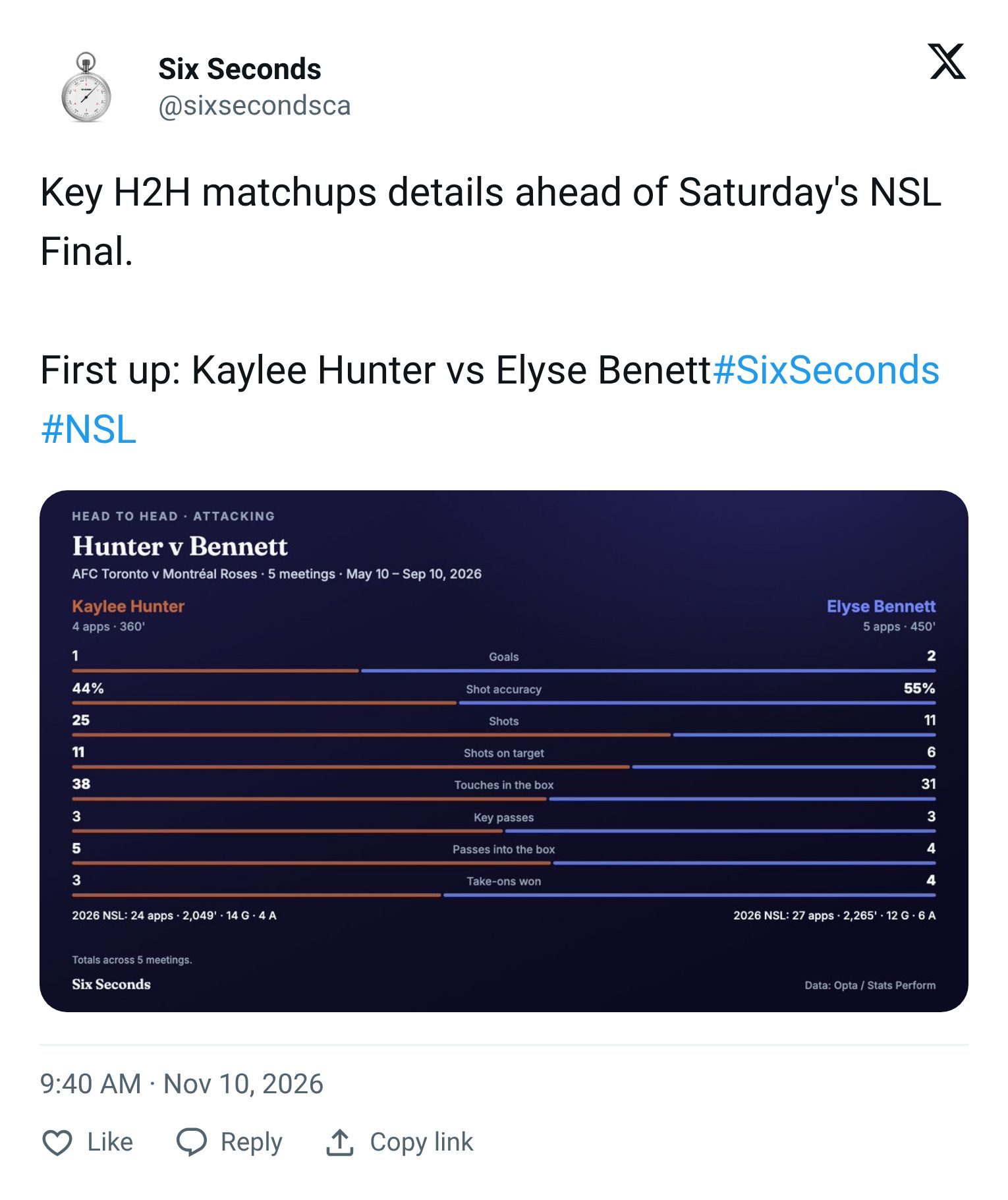
Hunter vs Bennett: who decides the Final?
Two of the best strikers in the league go head to head for a championship. Hunter has a league-best 15 goals in all competitions, and she reached another level in the playoffs with four goals in the semifinals. She is a constant threat with her dribbling, technique, positional awareness and shooting. She has already scored two stunning free kicks this season, including one against the Roses in July, so Montréal will need to limit fouls around the box.
Bennett sits third with 12 goals in all competitions, and she just broke a long dry spell with her goal against Vancouver on November 1. Even when she wasn’t scoring, she stayed consistent and shaped Montréal’s play. She knows how to stretch a defence, makes excellent runs in behind, and has built a strong connection with Alidou. Between them, they dismantled Vancouver in the first leg of the semis.
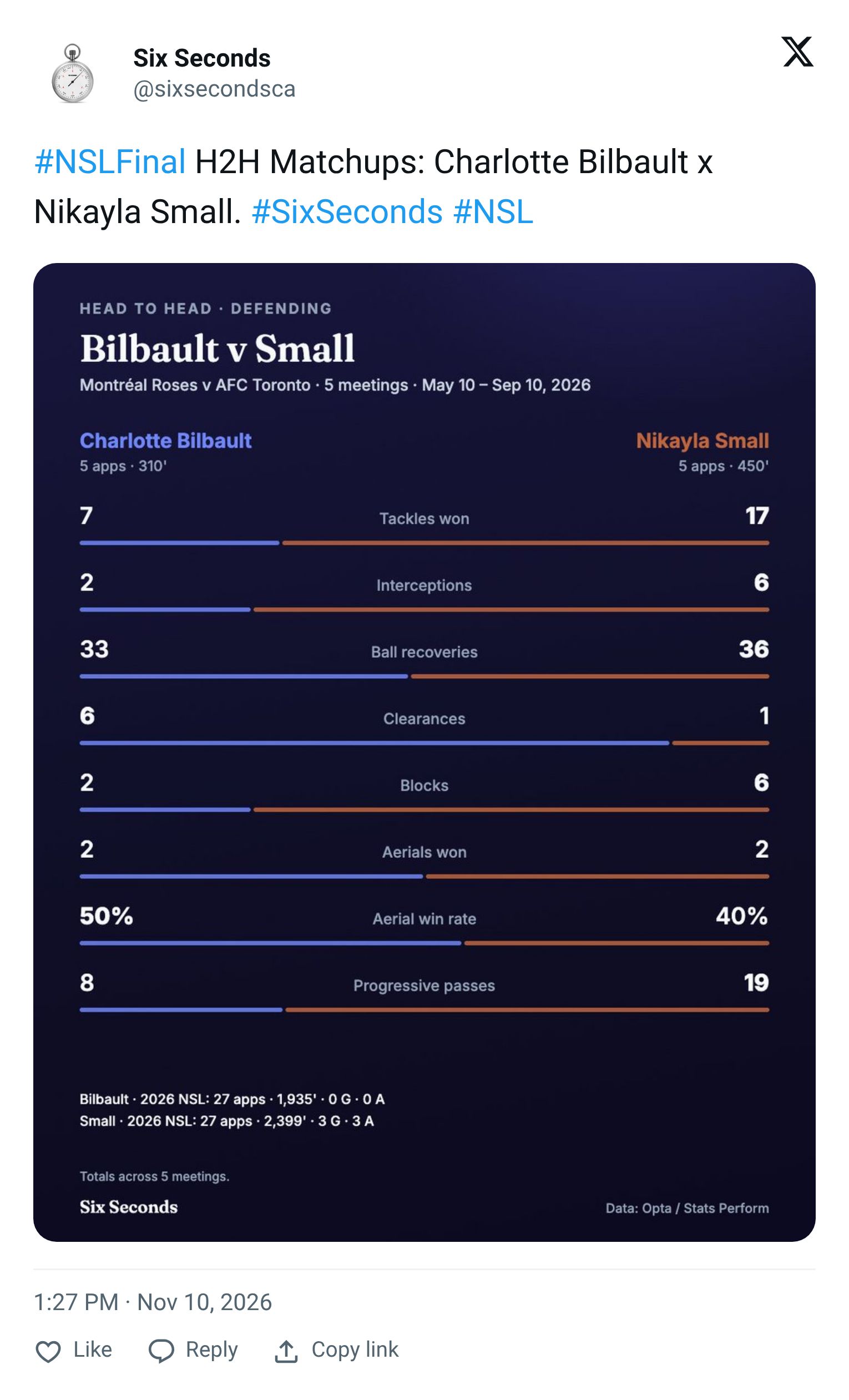
Small vs Bilbault: can the metronome keep ticking?
Two of the hardest-battling players in the league, both voted to the team of the year by their peers, sporting directors and broadcasters. Both are among the league’s top tacklers, but with very different profiles.
Bilbault’s mobility has been criticized this season, and Small in particular could expose it. With her low centre of gravity, spatial awareness and dribbling, she is a real threat. Her rotations and chemistry with Silano, Rowe and Hunter could pull Bilbault out of position and open up the back line to penetrating balls.

Nikki Small advances the ball | Photo Credit: Northern Super League
That said, Bilbault is Montréal’s metronome. The tactical change to deploy her further back as a deep-lying playmaker has masked her weaknesses and brought out her strengths. If she can stay on the ball and dictate play, she is the difference maker who lets the Roses play the way they do. She shoulders a lot of responsibility. Is the veteran French international up to the task, or will the young AFC Toronto captain prevail?
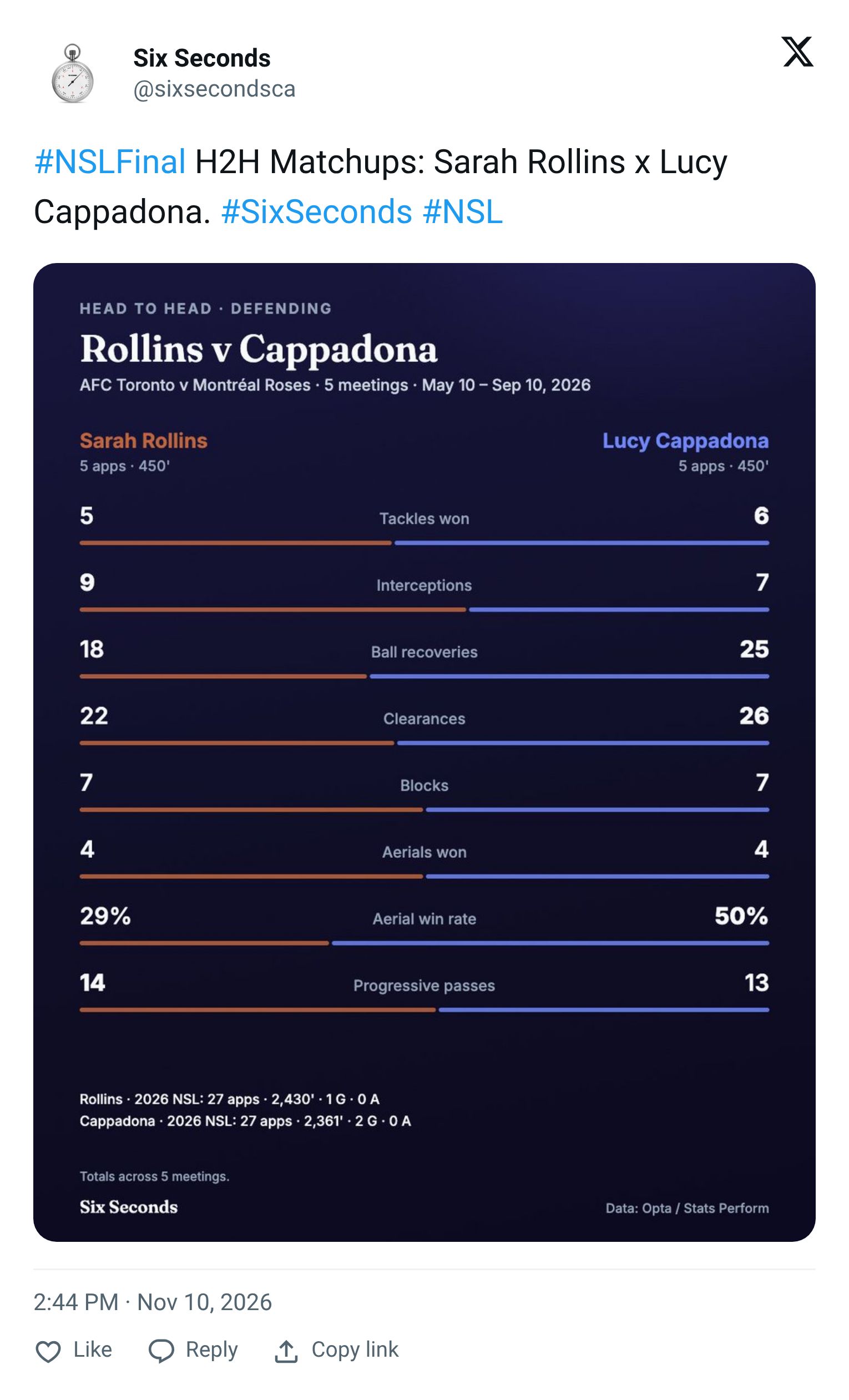
Cappadona vs Rollins
The two defensive stalwarts face off. Both are central to their teams’ build-up: Cappadona (snubbed for team of the year, in my opinion) has 1,672 passes and Rollins 1,410, good for second and fourth in the league. They drive their teams’ play and are expected to distribute from the back.
Cappadona will face intense pressure from Toronto’s press. Her ability to help break it will decide whether Montréal can establish their possession game. Rollins will not play in her best position, being shifted to right CB since late September.
Can Lambert hold off Hunter?
It has been a lot of Hunter vs Karpenko over the past two years, and no keeper has frustrated the young phenom more (cough, cough, BMO curse?). That won’t be the case this time, with veteran Lambert in goal because of Karpenko’s injury.

Hunter’s shot is saved off the line by Karpenko at BMO | Photo Credit: Northern Super League
Lambert has fit seamlessly into the team. She will need to be sure on the ball, ready to play as a sweeper-keeper, and show the shot-stopping ability we know she has. She has been here before. As SC Freiburg’s cup keeper, she was in goal for their run to the DFB-Pokal final in 2022–23, and she would give anything to change the colour of the medal to gold this time.
Predicted XIs
AFC Toronto (3-4-1-2)

With Vilgrain and Soto mysteriously listed as “unavailable”, Cathro is the only centreback on Toronto’s bench. With Zadorsky carrying a knock into the playoffs, this is a concern. Whatever the injury report says, expect Hunter and Zadorsky to start. These are mind games.
Montréal Roses (4-1-4-1)

It's a toss-up between Paquin and Boychuk in the right-wing position. Both had a goal contribution in the November 8th match vs Vancouver. Co-Captain Boychuk scored the Shield-winning goal off the bench in the last regular-season game.
Prediction
First, a confession: I picked Ottawa in the semis. Toronto had other ideas. Take this one with a grain of salt.
Toronto 2–1 Montréal
Montréal’s 12-game unbeaten run is real, but Toronto’s press gave the Roses more trouble than anyone in their last meeting, and Hunter is in the form of her life. Last year, the Shield winners fell at the final hurdle. I think history repeats itself, with Toronto on the other side of it this time.
What’s your prediction? Let me know on socials!
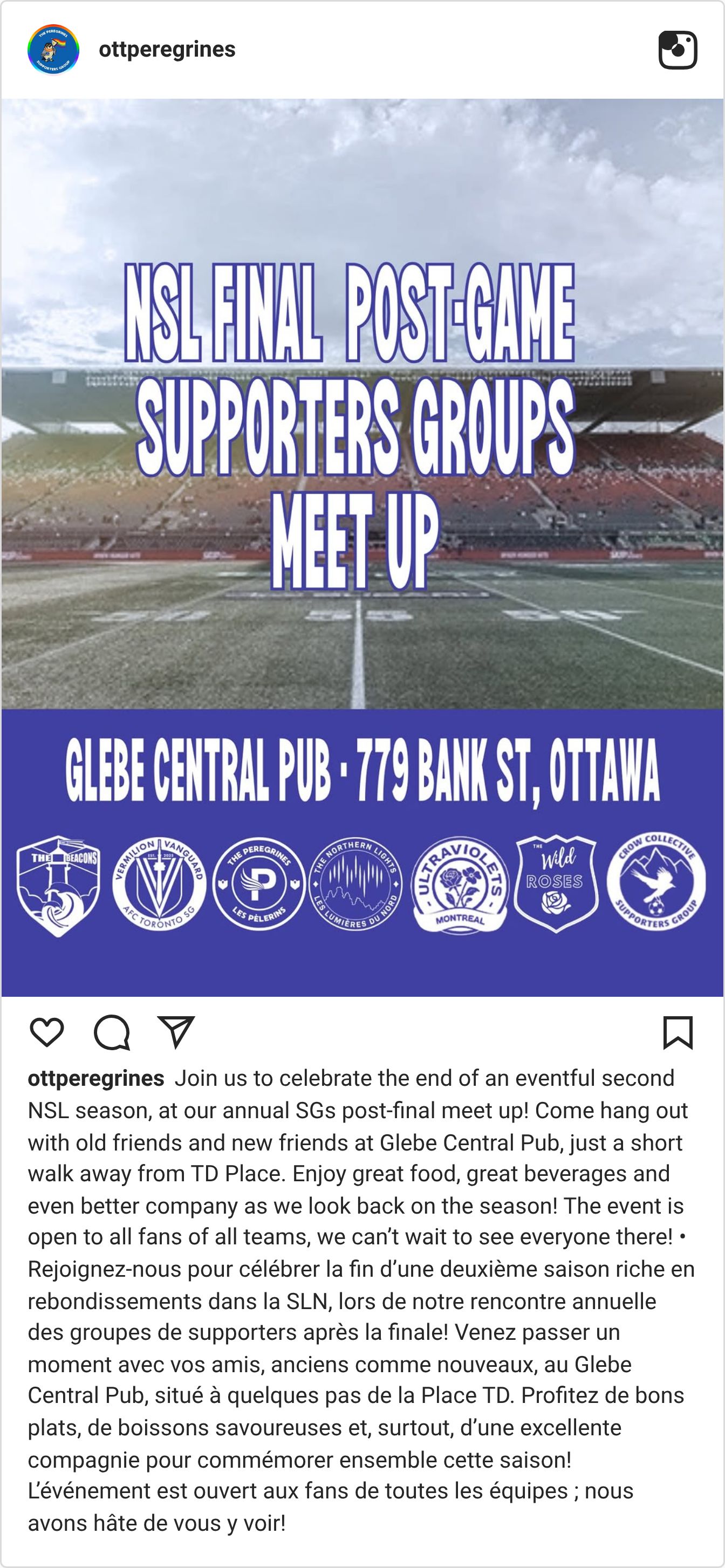
Let’s Meet Up in Ottawa
Both the Ultraviolets and the Vermilion Vanguard are expected to travel in numbers, and the natural Montréal vs. Toronto rivalry sets the stage for a competitive afternoon at TD Place. Get Final tickets if you haven’t yet!
In the days before, the NSL hosts Media Day and the Women’s Sport Now Conference. I’ll be in Ottawa for both, so follow along on socials and subscribe to the newsletter for photos, interviews, and more!
I will also be on site for the Broadscast Live Show, MD-1 Trivia Night, and hope to stop by the Northern Lights x Peregrines post-game party. Come say hi!